A hypothesis is a statement that can be tested by scientific research. If you want to test a relationship between two or more variables, you need to write hypotheses before you start your experiment or data collection.
Example: HypothesisDaily apple consumption leads to fewer doctor’s visits.
Published on
5 May 2022
by
Shona McCombes.
Revised on
30 January 2023.
A case study is a detailed study of a specific subject, such as a person, group, place, event, organisation, or phenomenon. Case studies are commonly used in social, educational, clinical, and business research.
Published on
5 May 2022
by
Shona McCombes.
Revised on
10 October 2022.
When you start planning a research project, developing research questions and creating a research design, you will have to make various decisions about the type of research you want to do.
There are many ways to categorise different types of research. The words you use to describe your research depend on your discipline and field. In general, though, the form your research design takes will be shaped by:
Published on
5 May 2022
by
Shona McCombes.
Revised on
10 October 2022.
Descriptive research aims to accurately and systematically describe a population, situation or phenomenon. It can answer what, where, when, and howquestions, but not why questions.
A descriptive research design can use a wide variety of research methods to investigate one or more variables. Unlike in experimental research, the researcher does not control or manipulate any of the variables, but only observes and measures them.
Published on
3 May 2022
by
Shona McCombes.
Revised on
10 October 2022.
When you conduct research about a group of people, it’s rarely possible to collect data from every person in that group. Instead, you select a sample. The sample is the group of individuals who will actually participate in the research.
To draw valid conclusions from your results, you have to carefully decide how you will select a sample that is representative of the group as a whole. There are two types of sampling methods:
Probability sampling involves random selection, allowing you to make strong statistical inferences about the whole group. It minimises the risk of selection bias.
Non-probability sampling involves non-random selection based on convenience or other criteria, allowing you to easily collect data.
You should clearly explain how you selected your sample in the methodology section of your paper or thesis.
Published on
15 April 2022
by
Shona McCombes
Revised on
3 September 2022.
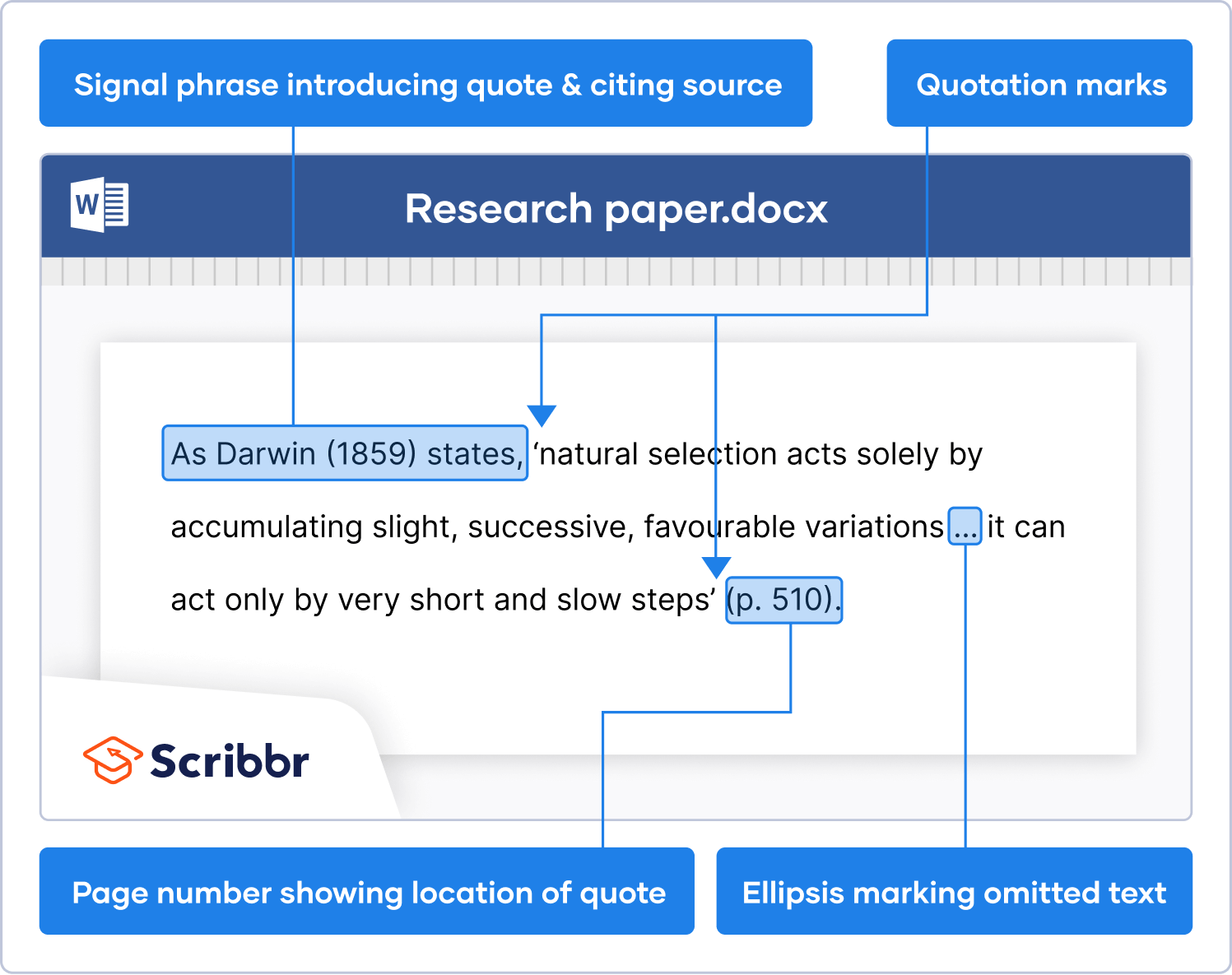
Quoting means copying a passage of someone else’s words and crediting the source. To quote a source, you must ensure:
The quoted text is enclosed in quotation marks (usually single quotation marks in UK English, though double is acceptable as long as you’re consistent) or formatted as a block quote
Published on
22 February 2022
by
Shona McCombes.
Revised on
7 June 2022.
What is a literature review? A literature review is a survey of scholarly sources on a specific topic. It provides an overview of current knowledge, allowing you to identify relevant theories, methods, and gaps in the existing research.
There are five key steps to writing a literature review:
A good literature review doesn’t just summarise sources – it analyses, synthesises, and critically evaluates to give a clear picture of the state of knowledge on the subject.
An abstract is a short summary of a longer work (such as a dissertation or research paper). The abstract concisely reports the aims and outcomes of your research, so that readers know exactly what your paper is about.
Although the structure may vary slightly depending on your discipline, your abstract should describe the purpose of your work, the methods you’ve used, and the conclusions you’ve drawn.
One common way to structure your abstract is to use the IMRaD structure. This stands for:
Published on
25 February 2019
by
Shona McCombes.
Revised on
10 October 2022.
Your research methodology discusses and explains the data collection and analysis methods you used in your research. A key part of your thesis, dissertation, or research paper, the methodology chapter explains what you did and how you did it, allowing readers to evaluate the reliability and validity of your research.